
By Michał Puchała · 2026-02-15 · 11 min read
Is Europe Completely Dependent on Microsoft?
Bill Gates was asked on Swedish television whether the US could cut off Europe's access to Microsoft. His answer should concern every European organisation running on Microsoft 365 - the dependency he was describing is documented, measurable, and deeper than most leaders acknowledge.
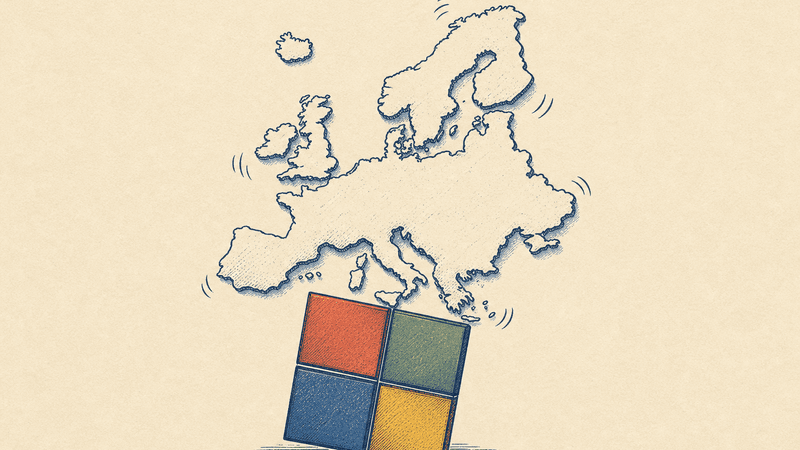
In January 2026, Bill Gates appeared on Swedish broadcaster SVT's programme Skavlan och Sverige. The host put a question to him that would have seemed absurd five years ago: could the United States decide to cut off Europe's access to companies like Microsoft?
Gates didn't dismiss it. "I would have been sure [it wouldn't happen] until recently," he told the programme, "and in three years I'll probably be sure again." He declined to speculate on what such a shutdown would look like, calling the thought "not very constructive."
What's constructive, though, is examining what it would actually mean - because the dependency he was asked about isn't hypothetical. It's measurable, documented, and deeper than most European leaders have been willing to acknowledge publicly.
The Scale of the Lock-In
The Open Cloud Coalition estimates that Microsoft holds 77% of the EU public sector's productivity software market. In specific categories the concentration is even starker: up to 84% in collaboration tools and 90–92% in office productivity across certain member states. Microsoft 365 is the default operating environment for email, document creation, internal communications, and increasingly, AI-assisted workflows across European governments, hospitals, universities, and enterprises.
This isn't just about office software. Microsoft's footprint extends through Azure cloud infrastructure, Active Directory for identity management, Windows as the dominant desktop operating system, and Teams as the standard collaboration platform. The European Council on Foreign Relations has estimated that 90% of Europe's digital infrastructure - cloud, compute, and software - is controlled by non-European, predominantly American companies.
The Swedish context that prompted Gates's interview is illustrative. In Sweden, experts have warned that the country's municipalities, government agencies, and businesses are deeply embedded in American cloud services. Swedish Prime Minister Ulf Kristersson acknowledged on SVT's Agenda that "all countries, including Sweden, are now looking very closely at the long-term dependency and what alternatives exist." Denmark's cybersecurity council has warned that the US could effectively shut down Danish digital infrastructure within hours. After the Greenland tensions escalated, Danish clients became among the most vocal in seeking alternatives to US cloud providers.
This Isn't Theory - It Already Happened
The scenario Gates was asked about isn't entirely speculative. In 2025, the International Criminal Court in The Hague found out what dependency on Microsoft looks like when political winds shift.
Following US sanctions on the ICC - imposed after the court issued arrest warrants related to the conflict in Gaza - chief prosecutor Karim Khan reportedly lost access to his Microsoft Outlook account. Microsoft has disputed the characterisation of events, but the ICC subsequently announced it would replace its Microsoft software entirely with OpenDesk, an open-source suite developed by Germany's Centre for Digital Sovereignty.
The incident crystallised a risk that had been discussed in abstract terms for years: a European institution conducting European legal proceedings could have its communications infrastructure disrupted by a US company complying with US foreign policy. Whether Microsoft proactively blocked access or the ICC preemptively switched is almost beside the point. The vulnerability was exposed.
As Mark Boost, CEO of UK cloud provider Civo, put it: "One line of testimony just confirmed that the US hyperscaler providers cannot guarantee data sovereignty in Europe." He was referring to Microsoft France's legal director Anton Carniaux, who testified under oath before the French Senate that he could not guarantee French citizens' data would remain inaccessible to US authorities.
The ECFR Scenario: What a US Technology Shutdown Would Look Like
The European Council on Foreign Relations didn't shy away from spelling out the consequences. In a December 2025 policy paper, the ECFR presented a scenario in which the US president issues an executive order granting powers to limit or shut down American digital services to foreign users, citing "European digital policies and taxes" as threats to American technology security.
The paper concluded bluntly: "Europeans cannot rely on either the self-interest of American technology companies or even themselves to keep Europe's computers on and its data centres running." Their recommendation - building a "EuroStack" of sovereign technologies across cloud, chips, AI, and space - is framed not as aspiration but as urgent necessity.
What makes this scenario particularly uncomfortable is that it wouldn't require dramatic government action. Microsoft's licensing model already gives the company significant operational leverage. Prices can be raised unilaterally - as they were when Dynamics 365 costs increased 10% in 2024 and AI Copilot was bundled into Microsoft 365 subscriptions at a higher price point. Features can be deprecated, as when Skype for Business was phased out in favour of Teams, fragmenting Sweden's government communications across half a dozen incompatible tools. Support for older systems can be withdrawn, as with the end of Windows 10 support in late 2025.
Each of these is a normal business decision. Collectively, they demonstrate how little control European organisations have over the infrastructure they depend on.
The Countries Already Moving
Germany's Schleswig-Holstein is the most advanced example: 30,000 civil servants are being migrated from Microsoft to LibreOffice, Nextcloud, Open Xchange, and Thunderbird, with 24,000 already completed by late 2025. The state expects to save tens of millions of euros. Denmark's Ministry of Digital Affairs announced plans to phase out Microsoft Office across government departments, though it will continue using Windows. Denmark's digital minister stated: "We must never make ourselves so dependent on so few that we can no longer act freely." France has been particularly active: the Ministry of Economics and Finance completed NUBO, an OpenStack-based private cloud, while some German states banned Microsoft 365 in schools over unresolved data protection concerns. Estonia is preparing contingency plans to ditch Microsoft if necessary. Sweden's eSAM initiative - a consortium of 40 government agencies - is developing Matrix-based open-source messaging to replace proprietary collaboration tools.
And France's National Gendarmerie has been running 103,000 workstations on open-source software since 2004, saving an estimated €2 million annually for two decades.
So Is Europe "Completely" Dependent?
Not completely - but dangerously close.
The honest assessment is that most European organisations, public and private, could not function for more than a few days without Microsoft products. Email would stop. Documents would become inaccessible. Identity systems would break. Collaboration would fragment. For many, the entirety of their digital workflow - from authentication to file storage to video calls to AI assistance - runs through a single US vendor.
The alternatives exist. Nextcloud, LibreOffice, Open Xchange, Element, Collabora, OpenDesk - these are mature, production-ready tools already deployed at scale in European governments. OVHcloud, Scaleway, Hetzner, and Open Telekom Cloud provide infrastructure that is headquartered in Europe and not subject to the CLOUD Act. The European Digital Infrastructure Consortium, established in July 2025 by Germany, France, Italy, and the Netherlands, is working to scale these tools across the continent.
But alternatives require migration, and migration requires planning. The organisations that started early - Schleswig-Holstein, the French Gendarmerie, the ICC - are already operational on European tools. Those that wait until a crisis forces their hand will face a far harder transition.
The question Bill Gates was asked on Swedish television wasn't whether Europe is dependent on Microsoft. That's settled. The question was whether that dependency could be weaponised. His answer - that he couldn't be as sure as he used to be - is probably the most honest assessment anyone at his level has offered.
European organisations would be wise to take that uncertainty seriously, while they still have time to plan.
At Cirran, we help European companies assess and reduce their dependency on US-controlled software and infrastructure - from sovereignty audits to migration planning for Microsoft alternatives. If your organisation is starting to ask these questions, get in touch for an initial assessment.